
Taxonomy, distribution & status
Taxonomy & genetics
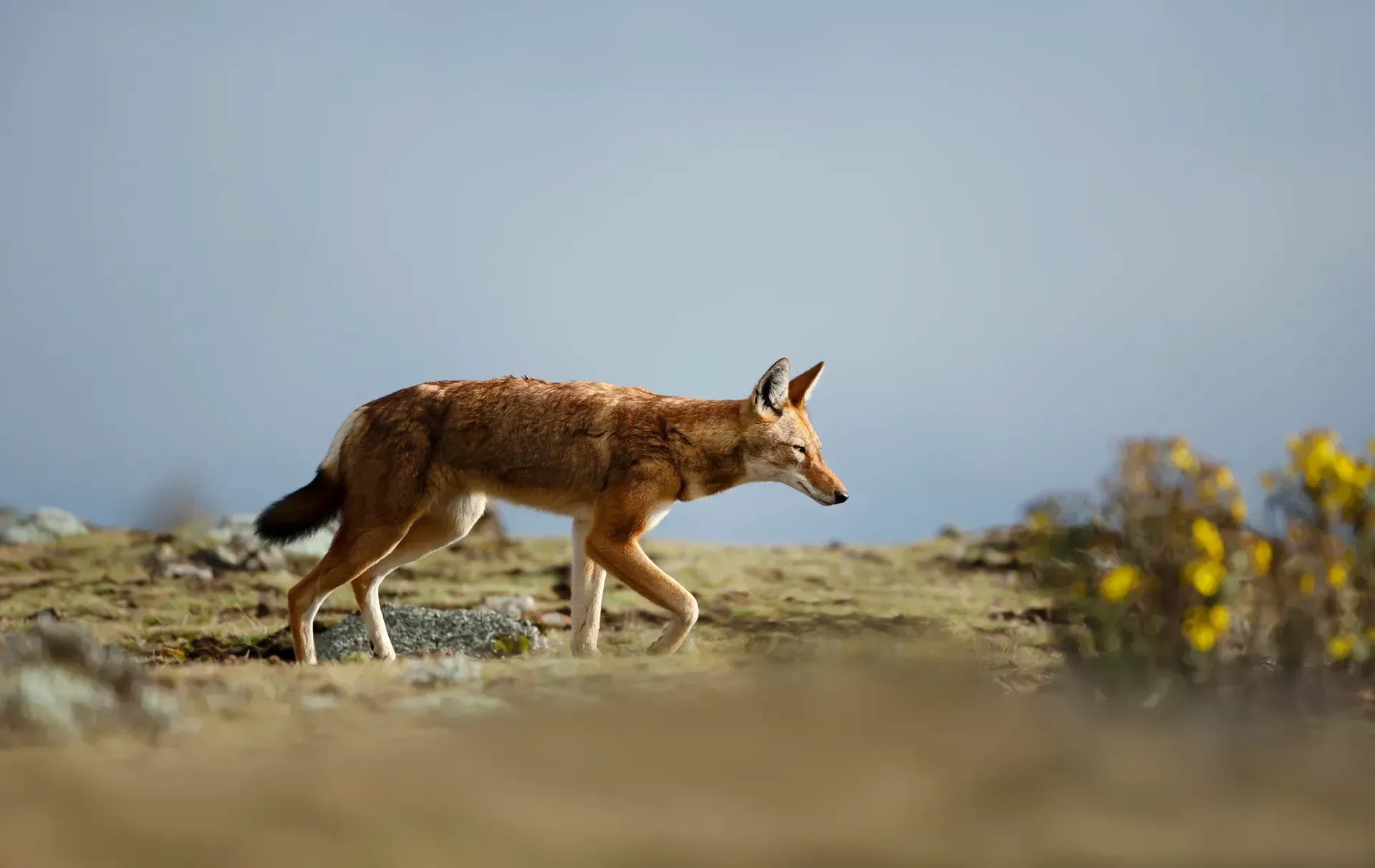
A wolf in fox clothing. It might look like a red fox or jackal, but the Ethiopian wolf is a recent descendant of a grey-wolf like ancestor that immigrated to Africa from Eurasia.
All wild canids are susceptible to pathogens transmitted from domestic dogs, which are numerous in the Ethiopian mountains and act as reservoirs for infectious disease.
Rabies is the most pathogenic and is almost invariably fatal. Rabies has been implicated in dramatic die-offs among African wild dogs, Blanford’s foxes, bat-eared foxes, and Ethiopian wolves.
Ethiopian wolf populations effectively are islands in a sea of dogs, and because of their closeness, rabies and canine distemper viruses are sometimes transmitted into the wolf population (Laurenson et al., 1998).
Long-term monitoring has revealed a series of wolf population crashes and recoveries in the Bale Mountains over the last 30 years. Recovery from epizootics indicate certain resilience, and is backed up by the re-active vaccination of wolf packs, but also highlights the significant threat that consecutive outbreaks would pose.
Distribution
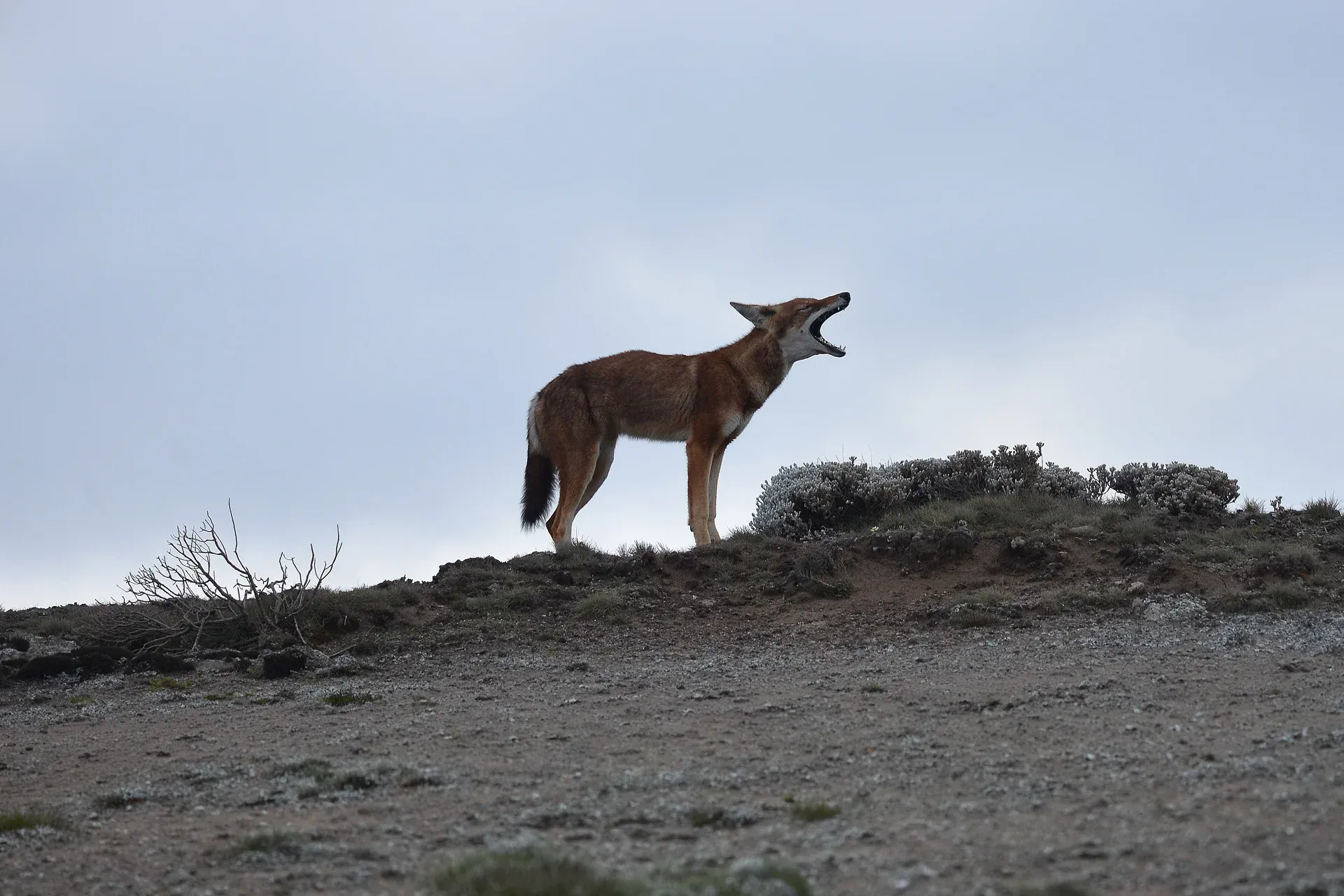
Small populations perch in small mountain enclaves, like islands in an ocean of agriculture and people.
The Ethiopian wolf is confined to high mountains on either side of Ethiopia’s Great Rift Valley, at altitudes between 3,000 and 4,500m (Gottelli & Sillero-Zubiri, 1992). They are restricted to land above the agriculture frontier, which in places encroaches up to 4,000m (Yalden et al., 1980; Marino, 2003).
There are six extant populations: Simien Mountains, North Wollo and South Wollo highlands, Guassa-Menz, Arsi Mountains and Bale Mountains; two recent extinct (Gosh Meda and Mt Guna) and one several decades ago (Mt Choke). These populations are by definition isolated from each others, as they are separated by distances larger than the potential dispersal of individual wolves (a conservative 20km from previous observations).
© Eric Bedin
Status
With less than 500 adults surviving, Ethiopian wolves are the rarest canid in the world and the most endangered African carnivore
With less than 500 adult individuals surviving, this distinctive carnivore remains the rarest canid in the world and the most endangered African carnivore.
The Ethiopian wolf has always been rare and, already in 1938 it was listed as requiring protection (Harper, 1945). Under Ethiopia’s Wildlife Conservation Regulations of 1974, it has full official protection -killing a wolf carries a sentence of up to two years in prison. In 1990, the species was classified by the IUCN Red List as Endangered (Ginsberg & Macdonald, 1990). In 1991-1992 a combination of rabies and shooting, triggered by political unrest, devastated the population of the Bale Mountains, the largest and best-known.
As a result the Ethiopian wolf was re-classified as Critically Endangered in 1994 (Sillero-Zubiri & Marino, 2008). Ten years later, when numbers finally recovered, it was down-listed to Endangered (IUCN criteria: < 250 mature individuals in the population; continuing decline in population size; < 250 mature individuals in each subpopulation) (Marino et al., 2006; Sillero-Zubiri & Marino, 2008).
Until recently two national parks protected the wolves’ Afroalpine habitat, Simien Mountains and Bale Mountains, but with the extension and creation of new protected areas, the range of wolf range under some form of protection increased from 40% in 2000 to 87% in 2011
Your support keeps us going
Together we can do this by strengthening our core projects: Monitoring & Research, One Health, Living with Wolves, Biodiversity Friendly Futures & Conservation Translocations
Together we can save Ethiopian wolves from extinction.